
Summer flower drop is not fate.
That simple truth sometimes returns to me
each time I step into a greenhouse in midsummer.
The air clings to the skin,
like a thin cloth draped over the shoulders.
The soil underfoot still holds moisture from the morning.
As I watch the faint droplets resting on the surface of the leaves,
I am reminded that plants, much like we do,
endure the heat and quietly move through each day.
And yet, what farmers fear most—deep down—
is the subtle sign of flower drop.
Flower clusters that stood firm just yesterday
suddenly begin to lose their strength.
In that moment,
time seems to pause ever so slightly,
and an unusual stillness settles in.
Even for those with years of experience,
the feeling is unsettling—
a quiet tension that never fully disappears.
In recent years, however, some growers have begun to sense
that something feels different during this season of uncertainty.
It is not a dramatic input.
Just silica—
a quiet material found everywhere in nature.
■ Flower Drop Begins Outside the Flower Itself
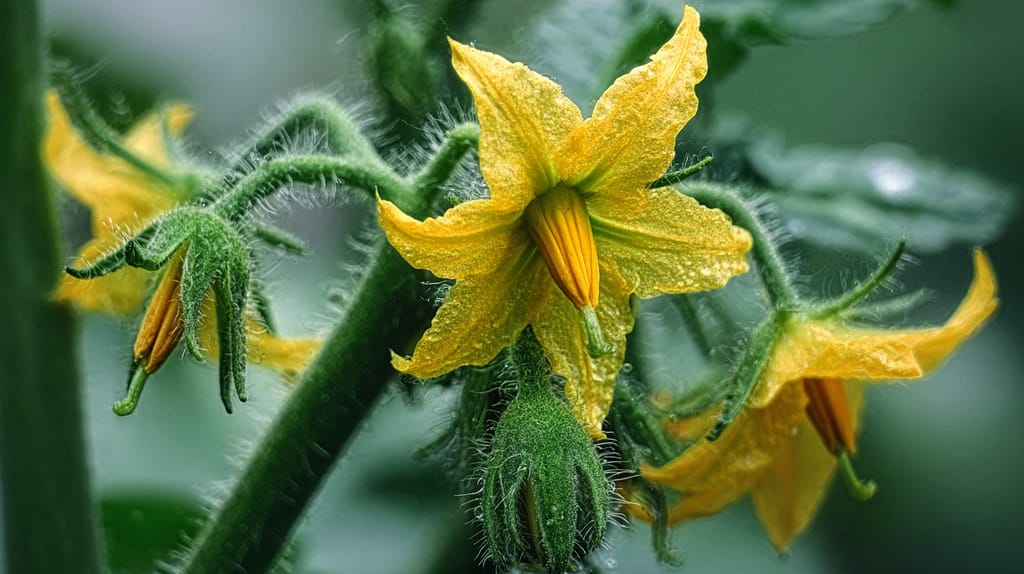
Tomato flowers are more delicate than they appear.
It is true that high temperatures are often said to disrupt pollination.
Yet in practice, the condition of the roots
and the function of the plant’s vascular system
are also thought to play a role.
When oxygen levels in the soil decline inside a greenhouse during midsummer,
roots can lose their ability to draw up water smoothly.
From there, the “water breathing” that sustains the flower clusters
tends to become unstable.
I recall reading in reports on bacterial wilt in Miyagi Prefecture
that stress in the root zone can accelerate the weakening of flowers.
In other words,
it may not be the heat itself that causes the flowers to fall,
but the fact that the plant has been pushed into a posture
where it can no longer withstand the heat.

■ Why Flowers Hold On in Fields Treated with Silica
A field does not lie.
Even on a midsummer afternoon,
when you encounter plants whose flower stems still point upward with quiet strength,
you sense—without needing an explanation—
that something inside the plant is well aligned.
There may be three underlying roles that silica plays,
but spelling them out too mechanically would miss the point.
Instead, let us look at them through the eyes of the field.
(1) A Sense of “Flowers That Do Not Give In”
The strength of cell walls is closely tied
to a flower’s ability to hold on.
Reinforcement associated with silica may not be visible,
yet it seems to act in subtle ways.
International research reports have presented data
linking silica application with overall plant soundness.
While often discussed in terms of disease indicators,
such findings may also reflect the idea of
a body that is less prone to breaking down.
Flowers that are harder to compromise
tend to keep their core intact,
even under intense heat.
(2) When Leaves Stay Calm, Flowers Can Keep Working
On bright afternoons with strong sunlight,
when leaves suddenly become overwhelmed,
the first strain is often felt by the flowers.
Silica is sometimes described as forming a thin layer on the leaf surface,
helping to moderate how light is received
and how moisture is retained.
Overseas studies have also reported on connections
between silica treatment and root condition.
When roots remain steady,
leaves do not panic—
and a margin of energy is preserved for the flowers.
That chain reaction may seem small,
but its impact can be surprisingly large.
(3) When Roots Are Stable, Flowers Often Appear More Settled
If you dig up plants that continue to drop flowers in midsummer,
you often find roots that are thin
and have lost their healthy whiteness.
Roots fatigued by heat appear
as though their breathing has become shallow.
Silica is thought to support root cell walls
and contribute to tolerance against moisture and low-oxygen conditions.
When this is combined with the soil-loosening nature of rice husk–derived silica,
fine air pathways can form around the roots,
helping respiration continue.
Roots that keep moving
maintain steady flows of water and nutrients toward the flower clusters.
Perhaps that is why the flowers appear calm and composed—
as a natural extension of what is happening below the surface.
■ Good Fields Have a Quiet “Posture” to Their Flowers
Fields tended by growers who work thoughtfully with silica
often share a certain calm.
Even toward evening, the flower clusters hold their form.
The leaves carry depth of color,
and new flower buds remain steady well into the later harvest period.
It is the kind of presence that naturally makes you think,
“This plant can carry on to the end.”
More than an impression,
it feels like proof that roots, stems, leaves, and flowers
are moving together as one integrated body.
■ We Cannot Change the Temperature —
But We Can Think About Building Plants That Hold Their Flowers More Steadily
Summers ahead are said to become even harsher.
Inside greenhouses reaching 35°C
with humidity near 90%,
it is no surprise that flowers are prone to drop.
And yet, by tending to the plant’s underlying condition,
a path remains—
one that allows flowers to endure even in the heart of the heat.
Rice husk silica is one material to consider
when thinking about:
- the structure of the plant body
- the condition of leaves and roots
Research data provides the backbone.
Practical, on-site experience adds the flesh.
When those two come together,
the result carries a quiet but compelling sense of conviction.
■ In Closing
Flower drop during periods of extreme heat
is shaped not by the heat itself,
but by a plant body that cannot withstand it.
Silica is a material that offers
a new way of looking at the plant’s growing environment.
We cannot change the temperature.
But we can cultivate the strength of the plant.By listening closely to the quiet power of natural materials,
we can hope that, even this summer,
flowers will move through the season
with resilience and grace.