
Does silica really change the taste?
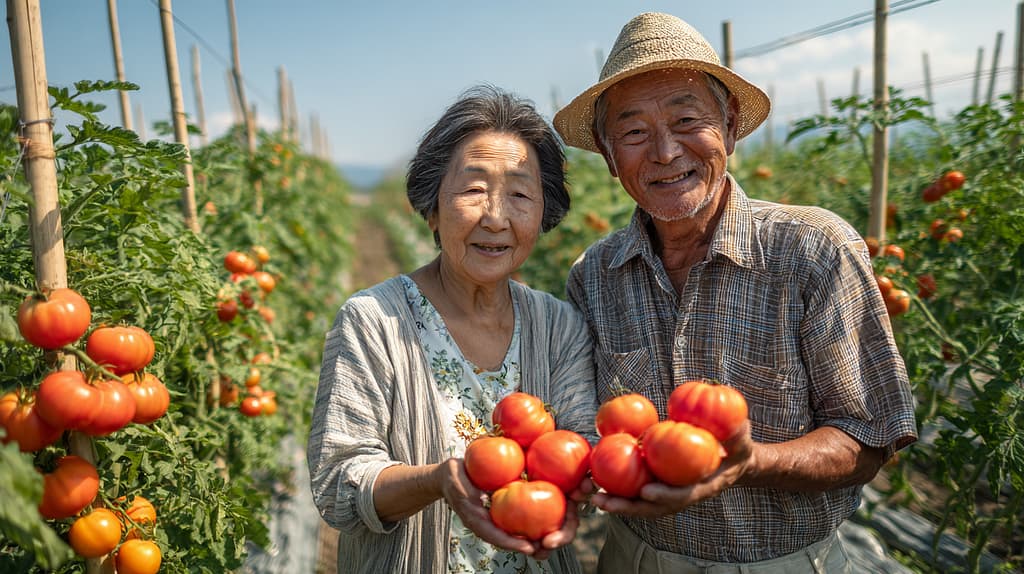
As I ask myself that question and look at tomatoes swelling red
under the summer sun,
it feels as though the answer draws a little closer.
That rich aroma spreading the moment you touch the harvest basket.
“These tomatoes are sweet this year.”
Moments like that—small yet certain—
become a quiet source of encouragement for growers.
In recent years, perhaps due to increasingly unstable weather,
more voices can be heard saying:
“The sweetness doesn’t develop,”
or “The heat makes the flavor feel thin.”
And yet, amid this uncertainty,
some farmers have begun to notice something—
not through dramatic changes,
but through slight adjustments in their cultivation approach.
“It feels like the sweetness leaves a stronger impression.”
Such realizations are shared quietly,
but they are becoming more common—
spoken not as claims,
but as observations born from standing in the field day after day.
Behind these quiet realizations lies cultivation that incorporates silica (silicon).
It is not a dramatic input.
Yet the more one works with it,
the more one begins to think,
“So this is how plants can protect their flavor.”
And behind the on-site feeling—
“It seems like the sweetness leaves a stronger impression”—
there is a research perspective that looks closely at the condition of the plant itself.
■ Sweetness Emerges from the Quiet Coordination of Roots, Leaves, and Fruit
At the heart of tomato sweetness
is how smoothly a single flow can be sustained:
Photosynthesis → Leaves → Vascular pathways → Fruit
In midsummer fields, however,
this flow can easily become unstable.
Roots lose oxygen under high temperatures,
disrupting the rhythm of water uptake.
Leaves grow fatigued under intense light,
slipping into a state much like mild dehydration.
When water movement through the vascular system becomes uneven,
the transport of sugars to the fruit also tends to falter.
As a result,
growers may feel that the impression of flavor has weakened.
Many farmers have experienced that gap—
the difference between a tomato that satisfies
and one that feels somehow thin.
That is why the key question becomes:
How can we keep the work of roots and leaves from declining?
It is here that silica begins to play its role—
quietly, and without drawing attention.
■ The Role of Silica in Preserving the Underlying Conditions of Flavor
Silica is often considered well suited to tomato cultivation.
To avoid misunderstanding, the points below are limited strictly to effects
that have been confirmed or discussed in research data.
(1) Reducing Leaf Stress and Helping Maintain Photosynthesis
Silica has been reported to integrate into leaf cell walls,
contributing to greater tolerance to light and heat stress.
International studies have described relationships
between silica application, root condition, and photosynthetic activity.
When roots remain stable, water uptake is less likely to fluctuate,
allowing leaves to continue functioning.
When photosynthesis is maintained,
the flow of sugars toward the fruit is also less likely to become disrupted.
(2) Firmer Fruit Cell Structure, Helping Flavor “Hold”
Silica is known to play a role in reinforcing cell walls.
The International Journal of Molecular Sciences (IJMS) has published findings
showing physical strengthening of tomato cell structures.
Research examining the relationship between silica and cellular architecture
has drawn attention to how fruit condition may be influenced.
When professionals describe tomatoes as having
“firm flesh” or “a flavor that leaves an impression,”
those sensory observations may overlap with these structural perspectives.
(3) Helping Roots Continue Functioning Under High Temperatures
Root fatigue is one of the greatest factors
that can destabilize flavor under summer conditions.
Silica has been reported to support root cell walls
and contribute to tolerance against high temperatures, excess moisture,
and low-oxygen conditions.
In the case of rice husk–derived silica,
its porous particles can gently loosen the soil,
creating fine air pathways around the roots.
Some growers note that
“the root condition seems more stable, even in summer.”
Such observations have begun to draw quiet attention.
■ 〈What Is Happening in the Field〉
The Background Behind “Sweetness That Seems to Increase”
When farmers’ voices are considered together,
a set of shared tendencies begins to emerge:
- “The flavor seems less likely to fade during summer.”
- “The Brix number hasn’t changed much, but the taste feels richer.”
- “Even later in the harvest, the impression remains stable.”
- “The flesh feels denser.”
This often-mentioned “20 percent” is not a statistical figure.
It is closer to on-site perception—
a sense felt through daily harvesting and tasting.
What science points to, on the other hand,
is a change in the foundation:
silica helps support roots, leaves, and cellular structures,
reducing factors that can lead to a decline in sweetness.
What the field reflects is the outcome of that process:
the flavor is preserved, and a sense of richness remains.
As these two perspectives—
research-based understanding and lived experience—
slowly overlap,
the view that “silica-based cultivation helps stabilize flavor”
has likely begun to take shape.
■ In Closing
Silica is not a material that adds sweetness.
It does not increase sugars themselves.
Rather, it helps shape the foundation that allows sugars to be retained—
supporting root strength,
leaf function,
and the firmness of the fruit.
That is why, even under conditions such as:
- unusually hot seasons
- greenhouses where heat tends to build up
- the later stages of harvest, when plants are more prone to fatigue
some growers feel that the impression of flavor remains more stable.
Behind the phrase “it feels sweeter”
lies a quiet overlap of two things:
facts supported by research,
and summers of experience accumulated in the field.
Silica is not a material that creates sweetness.
It is a material that offers a new way
to reconsider the growing environment itself.
By listening closely to that quiet influence,
we can continue to reflect—
and learn—
from what the field tells us.